When You Actually Need to Pump.
Most Long Island homeowners over-pump or under-pump. Here's what we see on the truck every week.
You should pump soon if:
- Drains are slow and gurgling. Water rolling slowly out of the bathtub, or toilets bubbling when the washing machine drains, usually means the tank is near capacity.
- There's a soggy spot in the yard over the tank or leach field. Even if it hasn't rained recently. That's liquid pushing to the surface because it can't absorb downward.
- There's a sewage smell in the basement, the yard, or the downstairs bathroom. Not every smell is a cesspool problem, but most of them are.
- It's been more than three years since the last pumping. Even if nothing feels wrong.
- You're listing the house for sale. Most Long Island real-estate buyers' agents ask for a recent pumping receipt.
- There's been heavy rain and the tank smells or the grass is dying. A flooded leach field pushes wastewater back into the tank faster than usual.
You probably don't need to pump yet if:
- It's been under 18 months since a full pumping and nothing's acting up.
- There's a soggy spot in one part of the yard that's unrelated to your septic layout (check for broken sprinklers or roof runoff first).
- Somebody at your door told you you need emergency service but didn't show you anything to back it up. The door-to-door pumping scam is real on Long Island, especially in older North Shore neighborhoods.
See our pumping cadence chart by household size for the full schedule.
What Happens When We Show Up.
1. Dispatch books the slot. We ask for the address, the problem, when you last pumped, and roughly how many people are in the house. Based on that, dispatch picks a 2,500-gallon, 3,500-gallon, or 5,000-gallon truck. Non-emergency pumping goes on the schedule within 48 hours most weeks. Emergency calls get a same-day truck.
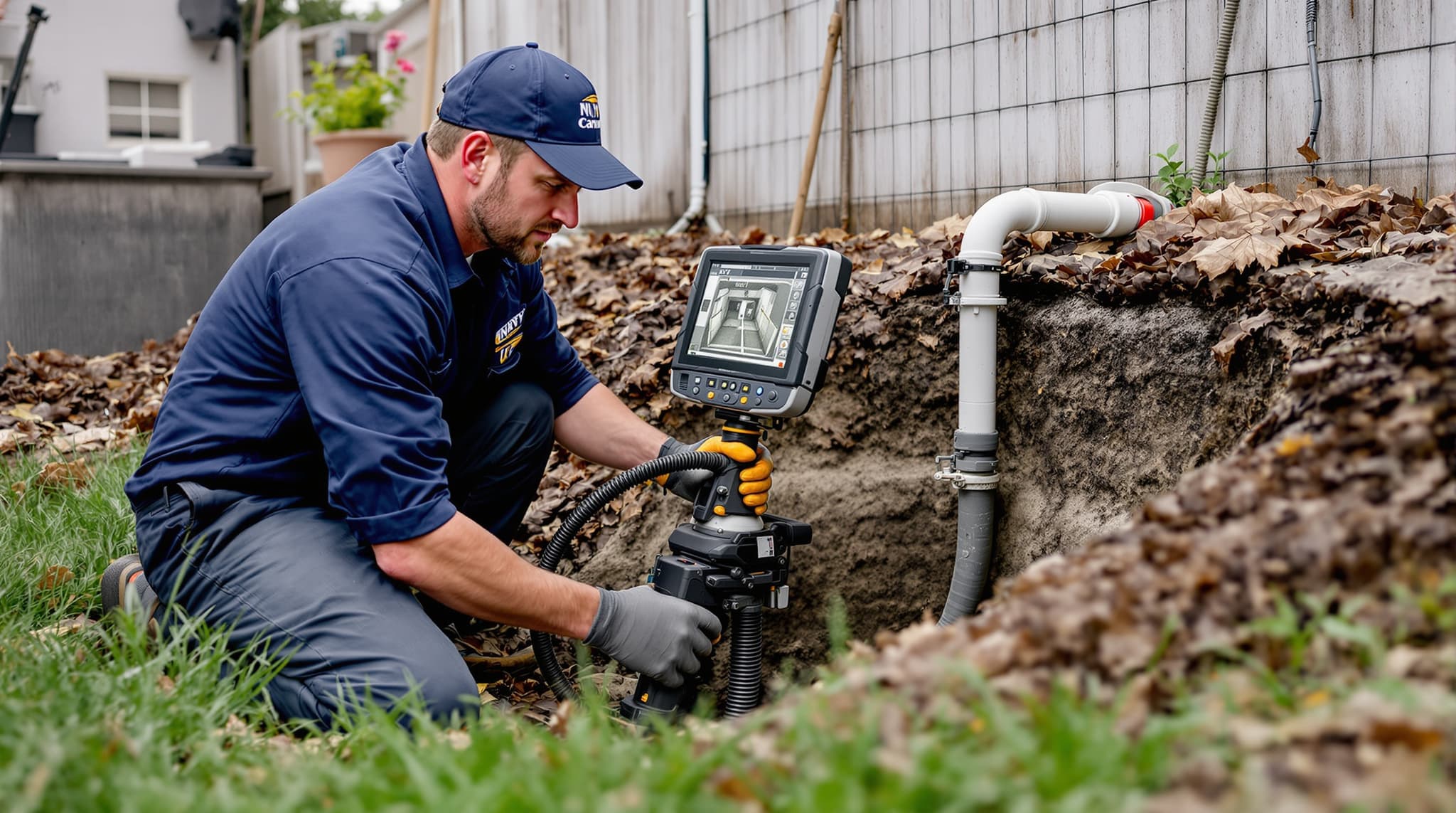
2. Tech locates the tank. If your tank lid is visible, two minutes. If it's buried under the lawn (most older Suffolk homes), we probe the ground with a soft probe rod to find the cover. We do not excavate the whole lid unless replacement is happening. On a routine pumping, we open just enough to work.
3. Written estimate before the hose comes off. Standard pumping. Additional hoses. Root cutting if we find root intrusion. Baffle replacement if we find a broken baffle. Each line item has a price next to it. You sign, we pump. If we find something mid-job that we missed on the estimate, we eat the difference.
4. Pumping. 45 to 90 minutes for a typical residential tank. The tech watches the flow, checks for sludge layer depth, looks for structural cracks in the tank walls, root intrusion, whether the inlet and outlet baffles are intact, and whether the leach field appears to be absorbing.
5. Inspection and report. We leave you a written service record covering tank condition, sludge level at pumping, any issues observed, and our recommendation for when to pump again. This paper goes on file and becomes valuable when you sell the house.
6. Waste hauling. We haul what we pump to an SCDHS-permitted transfer station. We carry the manifest, so if you ever need to prove proper disposal, the paperwork is on file.
What We Actually Check While the Tank Is Open.
A good pumping is more than vacuum. We use the visibility to catch problems early. Here's what the tech looks for.
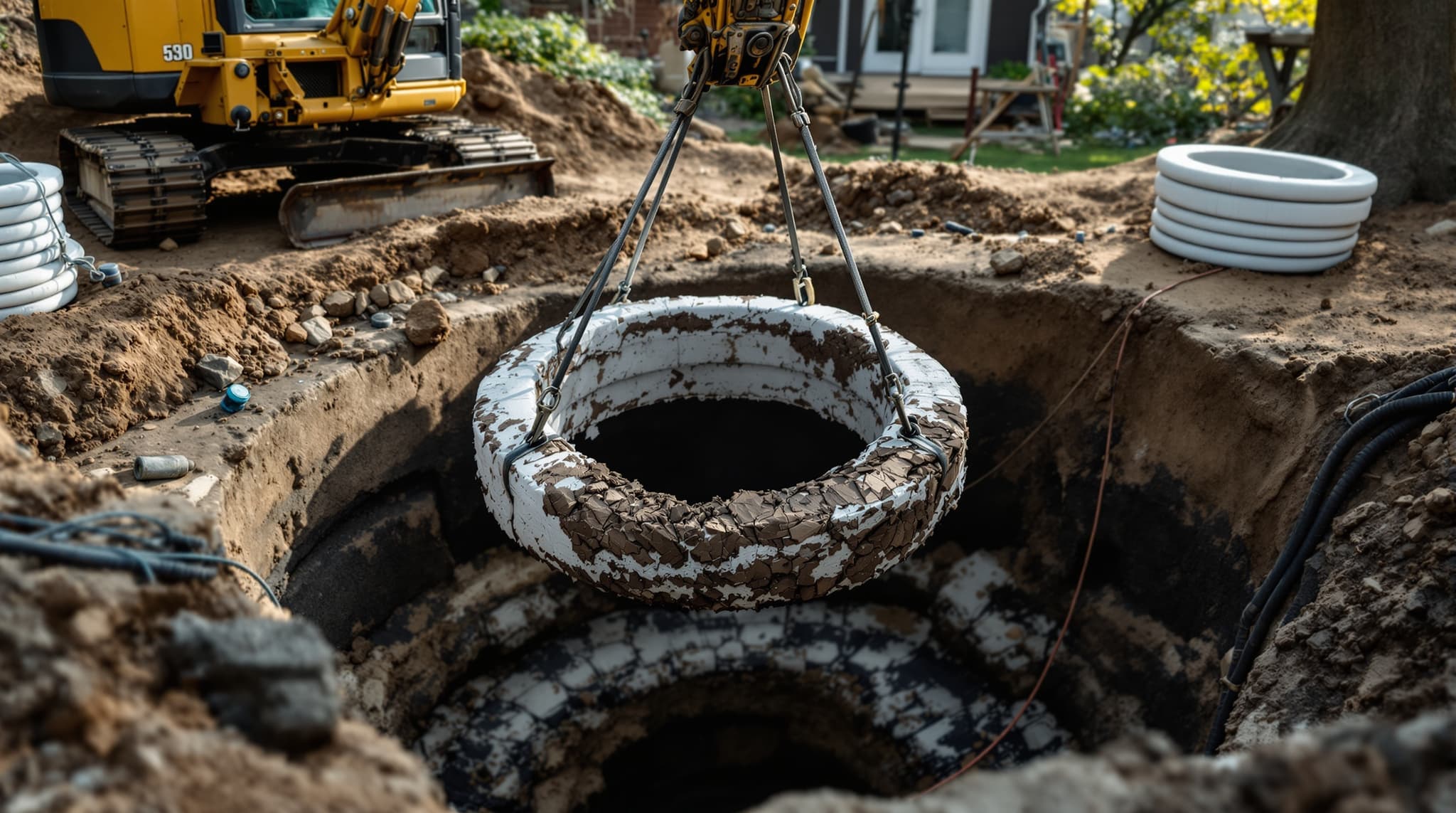
Tank structural condition. Cracked walls, collapsed sidewalls, corroded rebar, crumbling concrete. A failing tank is a replacement, not a repair. Catching it before it collapses under your front lawn saves thousands.
Baffle condition. The inlet and outlet baffles direct flow and hold back solids. A broken baffle lets sludge wash into the leach field, which kills the field fast. We replace broken baffles on the spot for a fair add-on price.
Root intrusion. Roots from nearby maples, oaks, and tulip trees work their way through the tank seams, looking for water. If we find roots, we cut them and flush. Chronic root intrusion needs a decision: pump-and-cut annually, or replace with a sealed modern tank.
Sludge level relative to capacity. This tells us your actual pumping interval. If a three-year interval pumps out a sludge layer that's almost touching the outlet, you need to shorten the cycle.
Effluent absorbing into the field. We run water into the tank after pumping to see if the leach field is accepting it. A field that backs up during a pumping is a field that's failing.
Surface conditions. Soggy spots, green-grass patches (the lawn over a failing field grows faster because of the nutrient load), broken risers, heaved ground.
Everything goes in the report. You get a copy, we keep a copy.
Why We Run Three Truck Sizes.
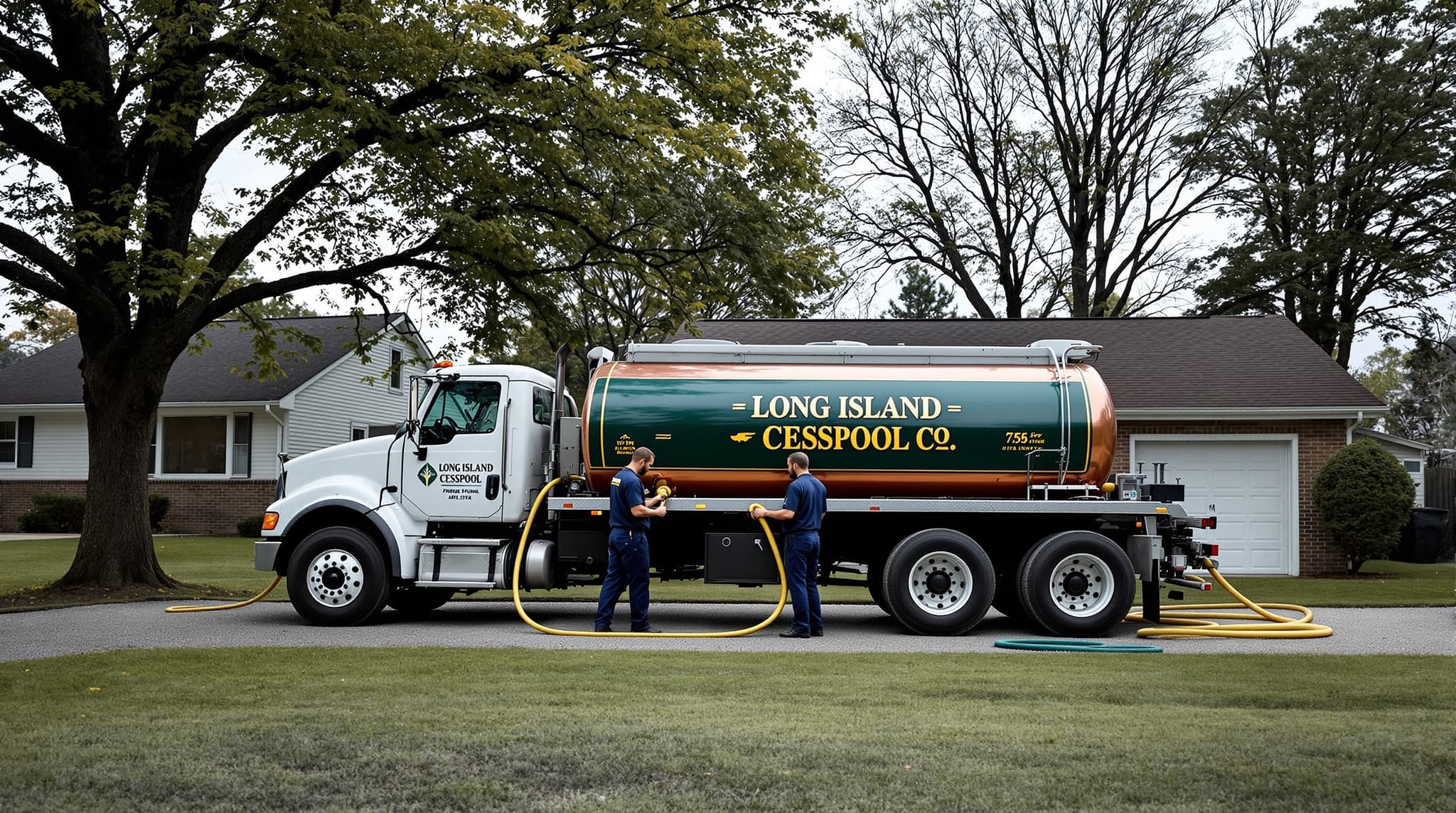
Most pumpers run one or two trucks and try to make them fit every job. We run three because residential cesspools, modern septic tanks, and commercial grease traps all have different volumes, and matching the truck to the tank saves you money.
- 2,500-gallon truck — Small Suffolk residential cesspools (single-ring, older South Shore construction). One load covers it. No second trip charge.
- 3,500-gallon truck — Most standard residential septic tanks (1,000 to 1,500 gallons of working volume) and mid-size commercial applications.
- 5,000-gallon truck — Large households, I/A systems, multi-tank commercial kitchens, grease trap haul-outs.
If dispatch sends the wrong truck, that's on us. You don't pay for a second trip.
On Pricing Your Pumping.
A handful of Long Island cesspool outfits advertise a low teaser rate (you've seen the "$179 pumping" billboard on Sunrise Highway). Some of them are honest low-cost operators. Most are not. Here's how the bait-and-switch works:
- Teaser rate quoted over the phone.
- Truck arrives, tech says the tank is "too big" or "overfilled" and quotes a much higher on-site number.
- Homeowner has already taken time off work, lawn is dug up, no real option to say no.
We don't work that way. Our quotes reflect what it actually costs to pump a tank, haul the waste to a permitted transfer station, pay a licensed tech, and maintain the truck. You can see rough pumping ranges on our pricing page. The written estimate you sign on site is the number you pay.
If you're getting a phone quote that sounds too low, it probably is. Ask what happens if the tank turns out to be bigger than estimated. Their answer will tell you everything.
Suffolk, Nassau, and Everywhere In Between.
We pump all over Suffolk and eastern Nassau. Common service areas include:
North Shore Suffolk: Huntington, Smithtown, Commack, Kings Park, Stony Brook, Port Jefferson, Setauket, Miller Place, Rocky Point, Wading River.
South Shore Suffolk: Babylon, Bay Shore, Islip, Sayville, Patchogue, Medford, Blue Point, Brookhaven, Mastic, Shirley.
Central Suffolk: Hauppauge, Nesconset, Ronkonkoma, Holbrook, Holtsville, Farmingville, Selden, Coram.
East End: Riverhead, Calverton, Aquebogue, Jamesport. (We serve the Forks on a limited basis, call for availability.)
Eastern Nassau: Massapequa, Bethpage, Hicksville, Plainview, Syosset, Farmingdale, Jericho.
See all Suffolk town pages for neighborhood-specific notes.